


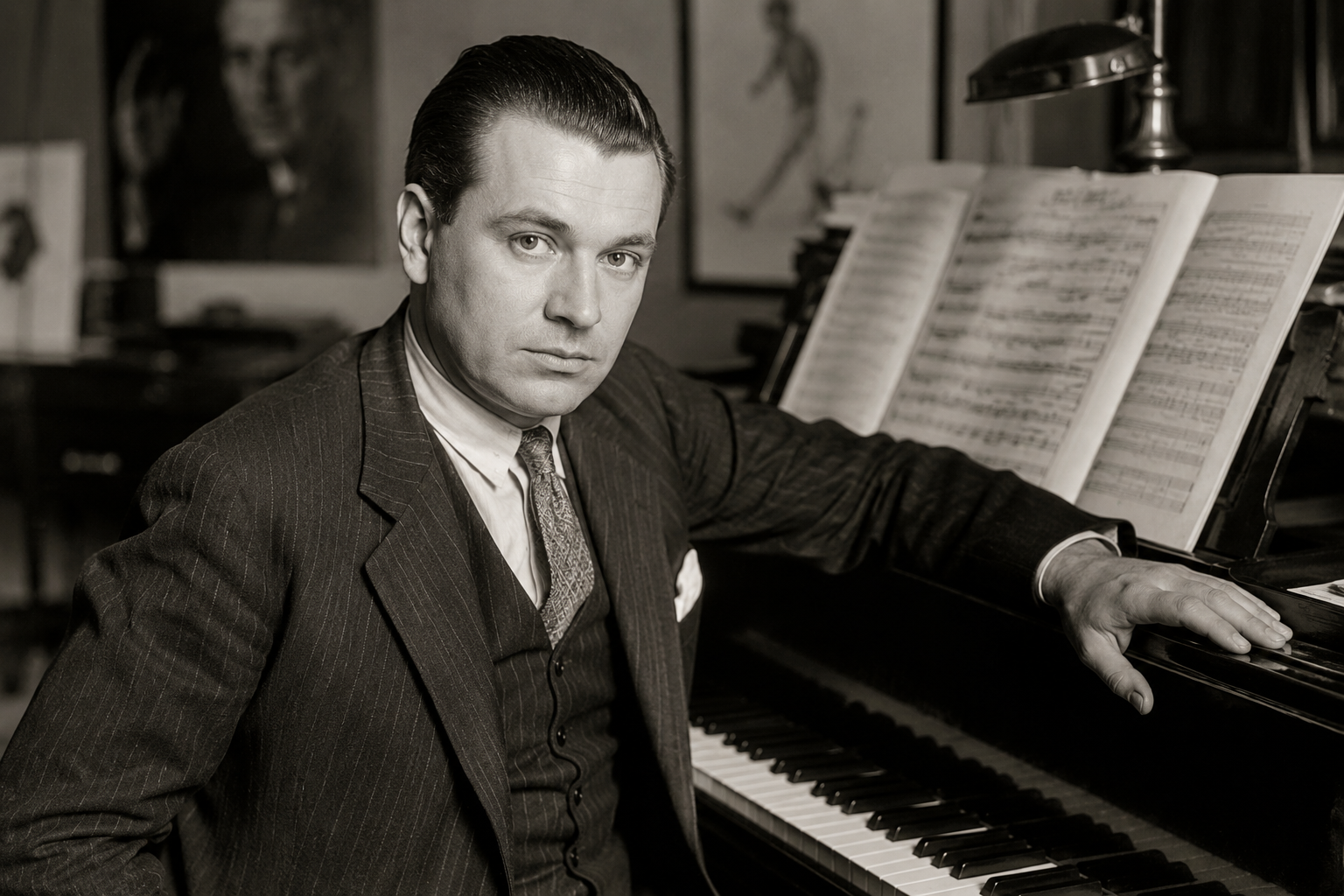
George Antheil and His Unusual Creative Vision
George Antheil was an American composer, pianist, writer, and inventor whose work challenged traditional ideas about what music could be. Born in 1900, he became known for combining bold rhythms, unconventional sounds, and modernist ideas with a fascination for machines and technology. His creative vision reflected the rapidly changing world of the early 20th century, making him an important figure in avant-garde music. Antheil did not simply follow established musical traditions; he wanted to create sounds that represented speed, industry, movement, and the energy of modern life. His willingness to experiment eventually made him one of the most distinctive and controversial American composers of his generation.
Early Life and Rise as an Avant-Garde Composer
George Antheil was born on July 8, 1900, in Trenton, New Jersey, and showed an early interest in music. He studied piano and composition before moving toward a professional career as a pianist and composer. His ambitions eventually took him to Europe, where he became closely involved with the artistic and musical circles of the 1920s. In cities such as Paris and Berlin, Antheil encountered modernist movements that encouraged artists to reject conventional forms and experiment with new approaches. His performances became known for their intensity and unconventional character, helping establish his reputation as a provocative young musician.
During this period, Antheil developed a distinctive musical language built around rhythm, repetition, mechanical sounds, and unusual instrumentation. He was fascinated by the relationship between music and modern machinery, an interest that separated him from many traditional composers of his time. His European years also brought him into contact with influential creative figures, including Igor Stravinsky and other members of the avant-garde. Rather than treating music as something limited to established concert traditions, Antheil viewed it as a medium capable of expressing the energy and technology of the modern world. This approach laid the foundation for some of his most ambitious experimental compositions.
How Ballet Mécanique Changed Modern Music
Ballet Mécanique became one of George Antheil’s most famous and controversial compositions, reflecting his fascination with machines, repetition, and modern industrial life. Created in the 1920s, the work was designed around an unusually large and unconventional combination of instruments, including player pianos and percussion. Instead of following the smooth melodies and traditional structures audiences expected from concert music, Antheil emphasized powerful rhythms, repeated patterns, and mechanical energy. The result was a bold musical experiment that challenged listeners and demonstrated how technology could influence artistic expression. Ballet Mécanique ultimately became an important example of musical modernism and remains central to discussions of Antheil’s creative legacy.
George Antheil and the Machine Age
The Machine Age had a strong influence on George Antheil’s artistic imagination. During the early 20th century, rapid developments in automobiles, factories, aviation, recording technology, and industrial machinery were transforming everyday life. Antheil responded to this changing environment by creating music that could suggest the power, repetition, and speed of machines. Rather than avoiding industrial influences, he incorporated their spirit into his compositions through persistent rhythms, sharp contrasts, and unconventional instrumental combinations. This approach helped him develop a musical identity that sounded distinctly modern for its time.
Antheil’s fascination with machinery was also connected to his broader belief that technology could change the way people experienced art. His compositions often challenged performers and audiences because they required unusual coordination and rejected familiar musical expectations. Ballet Mécanique is perhaps the clearest example of this philosophy, but the mechanical concept appeared throughout his artistic thinking. By treating rhythm almost like a machine and musical patterns like moving parts, Antheil created works that reflected the excitement and uncertainty of technological progress. His experiments helped demonstrate that contemporary music could respond directly to the industrial world surrounding it.
His Connection With Hedy Lamarr and Technology
One of the most fascinating chapters in George Antheil’s life was his collaboration with actress and inventor Hedy Lamarr. During World War II, the pair developed a concept for a frequency-hopping communication system intended to make radio-guided torpedoes harder for enemies to detect or interfere with. Their 1942 patent described a method in which signals could rapidly change frequencies according to a synchronized pattern. Although the system was not immediately adopted for wartime use, the idea later became associated with the broader development of secure wireless communications and earned Antheil a unique place at the intersection of music, invention, and technology.
Music Beyond the Avant-Garde
Although George Antheil became famous for his radical experiments, his musical career was much broader than his early avant-garde reputation suggests. As his career developed, he explored different styles and wrote works for orchestras, chamber groups, piano, film, and other settings. His later compositions could be more accessible than his early experimental pieces, showing that he was not permanently tied to one musical style. This ability to move between experimental and more conventional forms reflected his wide-ranging interests and willingness to adapt as his career changed.
Antheil also became involved in film and television music, bringing his compositional skills to audiences beyond the traditional concert hall. His later work demonstrated that the same composer who had once shocked audiences with mechanical rhythms could also create music for more familiar dramatic and entertainment settings. This broader phase of his career is important because it shows the full range of his artistic development. Rather than being remembered only for Ballet Mécanique, Antheil can be viewed as a versatile composer who continually experimented with new ideas while responding to the changing cultural world around him.
George Antheil’s Writing and Cultural Influence
Beyond composing and performing, George Antheil was also an active writer whose interests extended into politics, culture, technology, and social commentary. His writing revealed the same curiosity and willingness to challenge conventional thinking that characterized his music. He published articles and books and used his public voice to discuss subjects far beyond the concert world. This multidisciplinary career helped establish Antheil as an unusual cultural figure who moved between music, literature, invention, and contemporary affairs. His ability to connect different fields contributed to his lasting reputation as an innovative and unpredictable creative thinker.
Why His Legacy Still Matters Today
George Antheil’s legacy remains significant because his work brought together music, technology, experimentation, and modern culture in ways that were unusual for his era. His willingness to challenge established musical conventions helped broaden ideas about composition and performance, while works such as Ballet Mécanique continue to attract interest from musicians, historians, and scholars. His experiments with mechanical rhythms and unconventional instrumentation also demonstrate how composers can respond creatively to major technological and cultural changes. Antheil’s career shows that innovation often comes from crossing boundaries rather than staying within a single artistic tradition.
His connection with technology has also given his legacy a second dimension. His collaboration with Hedy Lamarr demonstrated that creative ideas could move between seemingly unrelated fields such as music and communications technology. Today, Antheil is remembered not only for his compositions but also for his ability to imagine possibilities beyond conventional categories. His story remains relevant because it illustrates how artistic experimentation, curiosity, and technological thinking can influence one another, making him an enduring figure in the history of modern American culture.
Conclusion and FAQs
George Antheil left a distinctive mark on 20th-century culture by combining experimental music, technological ideas, writing, and an enduring interest in modern life. From the groundbreaking Ballet Mécanique to his collaboration with Hedy Lamarr, his career demonstrated a willingness to challenge boundaries and explore unfamiliar possibilities. His work continues to attract attention because it connects artistic creativity with the technological changes that shaped the modern world.
FAQs
1. Who was George Antheil?
George Antheil was an American composer, pianist, writer, and inventor known for experimental music and Ballet Mécanique.
2. What is George Antheil famous for?
He is particularly famous for Ballet Mécanique and his collaboration with Hedy Lamarr on a frequency-hopping communication concept.
3. When did George Antheil live?
George Antheil was born in 1900 and died in 1959.
4. What was George Antheil’s connection to Hedy Lamarr?
Antheil and Lamarr worked together on a patented frequency-hopping system designed for secure radio-guided communications.
